
Small-Batch Australian Condiments vs Mass-Produced Imported Sauces
·
SITA'S Fusion Flavours
A sauce made closer to home isn’t automatically the better fit. The small batch australian condiments vs mass produced imported sauces choice is less about labels and more about what’s in the jar, how it’s made and how its flavour works in your kitchen. A familiar imported sauce may suit weeknight cooking; a locally made chilli oil might bring a different kind of heat or aroma to the table.
It’s understandable to look for clues such as “artisan”, “Australian made” or “small batch”, but those claims don’t tell the whole story. Production scale and origin alone don’t guarantee a particular flavour or quality. Look for clear ingredient and origin information, then consider whether the condiment’s taste and texture suit the meals you actually cook.
This guide compares how small-batch and mass-produced condiments can differ, what to check on product labels and brand pages, and how to choose according to your taste, cooking and values. SITA’S Fusion Flavours offers one example of the small-batch Australian category, drawing on family recipes and Australian-sourced ingredients. The aim is a more confident pantry choice, without relying on stereotypes about local or imported products.
Key Takeaways
- Separate production scale from country of origin: “small-batch” and “Australian-made” describe different things, so check each claim on its own.
- Judge flavour by the recipe and ingredient details, not production scale alone. Look for clues that match the aroma, heat, crunch or balance you enjoy.
- For small batch australian condiments vs mass produced imported sauces, compare the available label and brand-page information, and treat missing details as unknown.
- Start with how you’ll use the condiment, then weigh flavour preferences, ingredient information and sourcing claims to find the right pantry fit.
- Use SITA’S as one example of the small-batch category, and assess its stated Australian-sourced ingredients and family-recipe heritage alongside the product details.
Small batch Australian condiments vs mass produced imported sauces: what are you comparing?
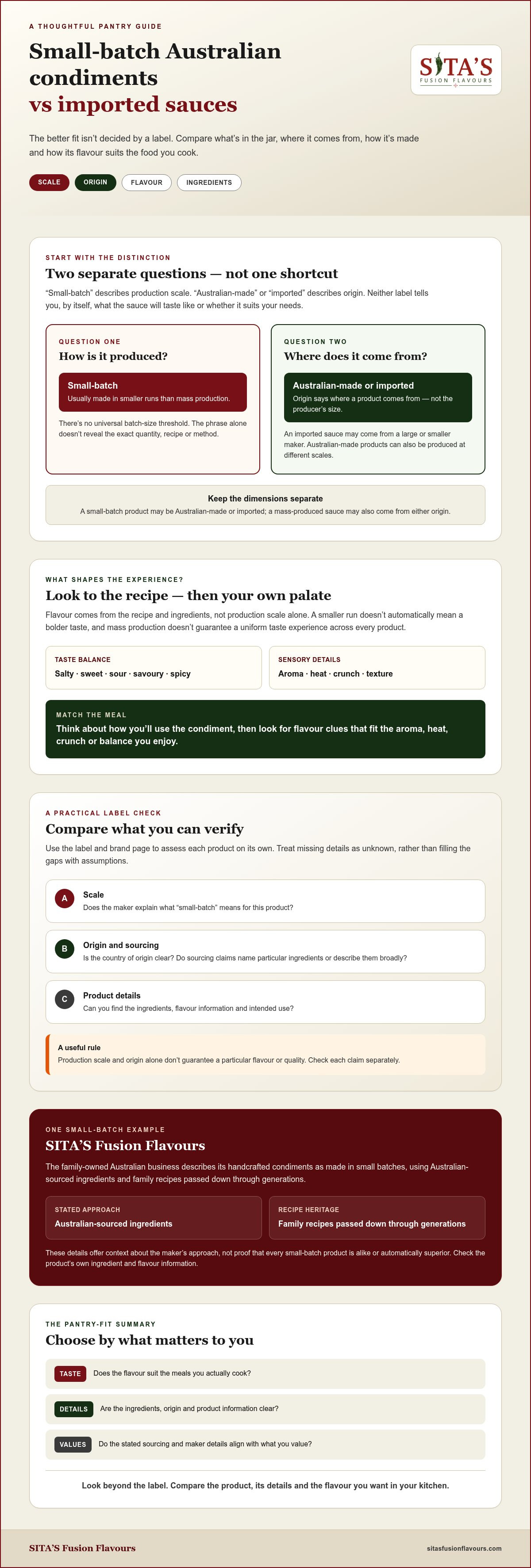
Before comparing jars, separate two ideas that are often bundled together: production scale and product origin. “Small-batch” describes how a condiment is produced, while “Australian-made” or “imported” describes where it comes from. Neither label, by itself, tells you whether a sauce will taste better, meet your needs or be made to a higher standard.
A condiment is a broad category of foods served with or added to a meal. For a quick overview of what condiments are, see the general definition. Here, the useful comparison is between products with different production scales and origins, not two fixed types with guaranteed characteristics.
What does small-batch mean for a condiment?
Small-batch usually means a maker produces a condiment in smaller runs rather than at mass-production scale. There’s no universal batch-size threshold, so the phrase alone doesn’t reveal the exact quantity, recipe or method. Look for useful detail on the label or brand’s website: who makes it, where ingredients come from, and what the maker shares about the recipe and product.
SITA’S Fusion Flavours is one example of an Australian small business that makes handcrafted condiments in small batches. The business describes its ingredients as Australian-sourced and its recipes as family recipes passed down through generations. Those are stated attributes to consider, not proof that every small-batch product is alike or automatically superior.
Does imported automatically mean mass-produced?
No. Imported tells you a product comes from outside Australia; it doesn’t tell you the producer’s size or how much they make. An imported condiment may come from a large manufacturer or a smaller maker. Likewise, Australian-made products can be produced at different scales.
Imported sauces also vary in style, ingredients and the detail available to shoppers. One label may give a clear ingredient list and origin information, while another may leave questions unanswered. Treat gaps as unknown rather than filling them with assumptions about the product or its maker.
So, the phrase small batch australian condiments vs mass produced imported sauces compares more than one factor. A small-batch product may be Australian-made or imported; a mass-produced sauce may also come from either origin. To keep the comparison practical, check each product on its own:
- Scale: Does the maker explain what “small-batch” means for its product?
- Origin: Is the country of origin stated clearly?
- Product detail: Can you find ingredients, flavour information and intended use?
These clues help you compare what’s actually in front of you, rather than letting “local”, “artisan” or “imported” decide the answer before you’ve considered the flavour you want.
How production scale and ingredient choices can shape flavour
A condiment’s flavour comes from its recipe and ingredients, not its production scale alone. The balance of salty, sweet, sour, savoury or spicy notes, along with aroma and texture, depends on what goes into the product and how it’s prepared. A smaller run doesn’t automatically mean a bolder flavour, just as mass production doesn’t guarantee a uniform taste experience across every product.
Start with the ingredient list and any flavour notes on the label or product page. Check whether sourcing claims name particular ingredients or simply describe them broadly. Sourcing can vary between products, even within the same production category, so don’t assume an Australian-made condiment uses only Australian ingredients, or that an imported one doesn’t explain its sourcing.
SITA’S Fusion Flavours provides one specific example: the family-owned Australian business states that it uses Australian-sourced ingredients and family recipes passed down through generations. These details offer context about the maker’s approach, but the product’s own information is still the best place to check ingredients and flavour details. For broader food standards information, consult Food Standards Australia New Zealand, which develops the Australia New Zealand Food Standards Code.
Consistency, character and sensory preference
Consistency is product-specific, not a guaranteed result of scale. A maker may aim for a familiar flavour from one run to the next, while ingredients or recipes can contribute to variation. A large producer may also offer consistency, but the label “mass-produced” alone doesn’t confirm how a particular product tastes or performs.
Think about the qualities you want in your pantry. Do you prefer a smooth sauce or a condiment with texture? Should its aroma be subtle or pronounced? How much heat suits your meal, and do you want sweetness or acidity to balance it? Compare product descriptions and ingredient information, then try a small amount in a familiar dish to judge how it works for you.
For more context on the making of this condiment style, read the guide to small-batch chilli oil. If you’re considering SITA’S, you can also explore its chilli oils and check the details for each product.
That’s the practical difference behind small batch australian condiments vs mass produced imported sauces: scale and origin can provide useful context, but your best flavour match comes from comparing the actual recipe, ingredients and product information.
Compare condiments by label, flavour and transparency: not assumptions
A fair comparison starts with evidence, not words that sound persuasive. “Artisan” and “authentic” may describe a maker’s positioning, but they don’t establish a particular production method, certification or level of quality. For small batch australian condiments vs mass produced imported sauces, compare the details each maker actually provides. If information isn’t stated on the label or product page, mark it as unknown rather than guessing.
| What to compare | Look for | If it isn’t stated |
|---|---|---|
| Origin | Declared country of origin and any specific sourcing claims. | Record the origin or ingredient source as unknown. |
| Ingredients | The ingredient list and any clearly explained ingredient details. | Don’t infer ingredients from the product name or images. |
| Flavour information | Descriptions of flavour, aroma, texture or heat level. | Don’t assume a chilli product’s heat or a sauce’s flavour profile. |
| Packaging | Container type, storage directions and any stated packaging claims. | Leave material, storage or environmental claims unconfirmed. |
| Intended use | Serving or cooking suggestions provided by the maker. | Don’t present an unlisted pairing as the maker’s recommendation. |
Which label details help you make a fair comparison?
Read the ingredient list, look for origin information, and note the manufacturer or responsible business details where available. A brand page can add context about sourcing or the maker’s approach, but keep claims tied to what it actually says. If you have questions about Australian food labelling, check current official guidance from the relevant Australian authority before drawing conclusions. A marketing phrase alone doesn’t confirm compliance, certification or a specific manufacturing process.
How to compare flavour and cooking uses
Think about the meals you want to lift and the flavour you enjoy: a gentle warmth, a pronounced chilli hit, a crisp texture or a more balanced savoury note. Use only confirmed descriptions from the label or product page. If one product lists its heat and another doesn’t, treat that difference as missing information, not proof that one is milder.
For a flavour-focused example, explore the chilli oil flavour guide. The simple shopper rule: compare documented product details, not category stereotypes. That keeps origin, scale and appealing label language in perspective while you choose what suits your pantry.
A practical checklist for choosing an Australian condiment
Start with the meal, not the marketing. A condiment for adding a quick hit of flavour at the table may need to do a different job from one you’ll stir through a dish while cooking. In the small batch australian condiments vs mass produced imported sauces comparison, neither category automatically suits every palate or pantry. Use this checklist to narrow down what you actually want.
- Decide how you’ll use it. Think of a dish you make regularly and whether you want a condiment to accompany it, add flavour during cooking or bring variety to familiar meals.
- Name your flavour preferences. Are you drawn to crunch, pronounced chilli heat or a more aromatic profile? Treat those as preferences to check against the product’s own description, not qualities to assume from its name or category.
- Check the ingredient details. Read the label and product page. Compare the listed ingredients, and note whether sourcing information is specific or broad. If an ingredient or claim isn’t explained, keep it as unknown.
- Look for useful product information. Check for flavour descriptions, intended uses and storage instructions. Missing details aren’t proof of poor quality, but they may be worth asking the maker about before you buy.
- Choose between familiarity and variety. A known flavour may suit a regular pantry staple; a different profile could add interest. Consider how often you’ll use it and whether the description fits your preferred level of heat and flavour.
Choose for your palate and pantry
Names can help you spot a range, but they don’t replace product details. SITA’S confirmed chilli oils include Crispy, Carolina Reaper, Habanero and Kaffir Lemongrass, among others; check each product’s current description and label for specific ingredients and flavour information rather than assuming what the name means. For broader pantry context, explore Malaysian-inspired condiment traditions.
Check what the maker tells you
Clear information makes comparison easier, whether the product is Australian-made or imported, small-batch or mass-produced. Look for ingredients, sourcing claims and storage guidance. If something important is absent, ask the seller rather than treating the gap as a verdict on quality.
Curious about SITA’S small-batch chilli oils? Explore the confirmed chilli oil range, then compare each product’s details with what you want from your pantry.
Explore SITA'S small-batch Australian condiments as one considered choice
SITA’S Fusion Flavours offers one example of the small-batch Australian category: a family-owned business making handcrafted chilli oils and Malaysian-inspired condiments in small batches. It states that it uses Australian-sourced ingredients and draws on family recipes passed down through generations. Those details provide useful context about the maker, while your own choice still comes down to the product information and flavours that suit your table.
A maker-led range with Malaysian-inspired roots
The confirmed chilli oil range includes Crispy Chilli Oil, Kaffir Lemongrass Chilli Oil, Ghostly Chilli Oil, Carolina Reaper Chilli Oil, Habanero Chilli Oil and Aji Limon Chilli Oil. These names give shoppers different options to explore, but don’t rely on a name alone to judge ingredients, texture or heat. Check the current product description and label for details about each one.
Family recipes can carry a sense of continuity from one generation to the next. They’re part of SITA’S stated story, not a guarantee that every small-batch condiment tastes a particular way or will suit every palate. For a food-use example that brings the brand’s Malaysian-inspired context into a meal, see the Malaysian chilli oil laksa recipe.
Take the next step at your own pace
Before choosing, compare the current product descriptions and ingredient details with what you enjoy and how you plan to use the condiment. You might be looking for a familiar pantry staple, or you may want to explore a different chilli oil variety. If an ingredient, sourcing detail or storage instruction isn’t clear, treat it as a question to check rather than making an assumption.
That’s a more useful way to approach small batch australian condiments vs mass produced imported sauces: assess the individual product, not a category-wide promise. Small-batch production, Australian sourcing and family heritage may matter to your choice, while another shopper may prioritise a familiar flavour or a different origin. Neither preference needs to be the default.
Ready to compare for yourself? Explore SITA'S Fusion Flavours, read the product details and choose a condiment that fits your taste and pantry needs.
Choose the condiment that earns its place in your pantry
The best choice isn’t decided by a jar’s origin or production scale. For small batch australian condiments vs mass produced imported sauces, focus on what the product tells you: its ingredients, sourcing, flavour description and how you plan to use it. If a detail matters to your decision but isn’t provided, treat it as unknown and check before buying.
Then trust your own palate. A familiar sauce may be just right for everyday meals, while another condiment could bring a welcome change to the table. The useful comparison is the one that helps you choose with confidence, not the one that starts with assumptions.
SITA’S Fusion Flavours is one option to consider: a family-owned Australian small business making condiments in small batches, with Australian-sourced ingredients and family recipes passed down through generations. Explore the product details at your own pace and see what fits your cooking and taste.
Explore SITA'S handcrafted condiments, and enjoy finding the flavours that make your next meal feel more like yours.
Frequently Asked Questions
Are small-batch Australian condiments better than mass-produced imported sauces?
Not automatically. Production scale and origin don’t guarantee better flavour, safety or quality. In the small batch australian condiments vs mass produced imported sauces comparison, assess each product on its own: read the ingredient list, consider the flavour information and check what the maker says about sourcing. Then decide whether the described taste, texture and intended use suit your meals. A small-batch product or an imported sauce may be the better fit for your pantry.
What does small-batch mean for Australian condiments?
Small-batch generally means a condiment is made in smaller production runs, but there’s no universal batch-size threshold. The term describes scale, not a particular recipe, ingredient standard or flavour. Check the product label or maker’s website for details about ingredients, sourcing and the production approach. If those details aren’t provided, treat them as unknown rather than assuming what “small-batch” means for that specific product.
Can imported sauces be high quality?
Yes. “Imported” describes a product’s origin, not its quality or the size of the business that made it. Imported sauces can differ in ingredients, flavour, intended use and the information available to shoppers. Read the label and product description, and compare what’s documented with your preferences. Don’t dismiss a sauce because it’s imported, or assume it’s right for you without checking the product details.
How can I tell whether a condiment is made in Australia?
Check the packaging for country-of-origin information, then compare it with the maker’s product page if you’re shopping online. Look carefully at what the claim refers to: where the condiment is made and where its ingredients come from are separate details. If the wording is unclear, consult current Australian food-labelling guidance or ask the business for clarification. Don’t treat a general “local” or “artisan” description as a complete origin statement.
Does small-batch production mean a condiment has better ingredients?
No. Small-batch describes production scale; it doesn’t establish which ingredients are used or whether they’ll suit your preferences. Check the ingredient list and look for specific sourcing information on the label or product page. If a claim is broad or a detail isn’t stated, don’t fill the gap with assumptions. SITA’S Fusion Flavours, for example, states that it uses Australian-sourced ingredients, but check each product’s current information for its details.
How should I choose between chilli oils with different flavour profiles?
Start with how you’ll use the oil and what you enjoy: a familiar flavour, a different aroma, texture or level of heat. Check the product description and ingredient list rather than relying on a name to predict precise flavour or intensity. SITA’S confirmed options include Crispy Chilli Oil, Kaffir Lemongrass Chilli Oil and Habanero Chilli Oil. Compare their current product details with your preferences before choosing.
Are Australian-made condiments always made with Australian ingredients?
No. “Australian-made” and “Australian-sourced ingredients” describe different things, so one claim doesn’t automatically confirm the other. Check the packaging and product page for information about both the product’s origin and ingredient sourcing. If the sourcing detail matters to you but isn’t clear, ask the maker. SITA’S Fusion Flavours states that it uses Australian-sourced ingredients, but ingredient information can vary from one condiment to another, so review the current product details.