
Looking for a Preservative-Free Alternative to Commercial Chilli Crunch?
·
SITA'S Fusion Flavours
What if “preservative-free” isn’t the first thing to look for? If you’re searching for a preservative free alternative to commercial chilli crunch brands, ingredient transparency, safe handling and the kind of crunch you enjoy all matter. A label can offer useful clues, but unfamiliar ingredient names can make it hard to understand what it tells you.
It’s understandable to wonder whether skipping preservatives means sacrificing safety or shelf life. The answer depends on the product and its handling instructions, so read the label rather than guessing. This guide explains what ingredient lists can and can’t tell you, which food-safety details to pay attention to, and how to compare commercial and handcrafted chilli condiments for flavour and texture, not just heat.
We’ll also look at Crispy Chilli Oil from SITA'S Fusion Flavours, a handcrafted option from a family-owned Australian maker, shaped by small-batch production and Malaysian-inspired family recipes. By the end, you’ll have a clearer way to choose a chilli crunch alternative that suits your palate and pantry, and follow its storage directions with confidence.
Key Takeaways
- Read ingredient lists as useful information, not proof that a chilli condiment is safer, healthier or higher quality.
- Preservative-free describes a shopper preference. It doesn’t determine a product’s safety or storage needs on its own.
- Compare crunch, heat, aromatics and provenance alongside ingredients to find a preservative free alternative to commercial chilli crunch brands that suits your palate.
- Choose according to your ingredient preferences, then follow the product’s storage directions carefully.
- Explore Crispy Chilli Oil from SITA'S Fusion Flavours as a handcrafted, small-batch chilli condiment inspired by Malaysian flavours and family recipes.
What does a preservative-free alternative to commercial chilli crunch mean?
Searching for a preservative free alternative to commercial chilli crunch brands usually reflects a preference about ingredients. It doesn’t, by itself, tell you whether a product is safer, better quality or more nutritious. Chilli crunch recipes vary, and the words on the front of a jar are only one part of the picture.
Start with the full ingredient list. It can help you identify ingredients you prefer to avoid and understand what contributes to a product’s taste and texture. It won’t explain every detail of how the product was made or establish that it’s safe in every storage situation. Read packaging claims alongside the complete ingredient and storage information.
What counts as a commercial chilli crunch?
Commercial chilli crunch is a broad category of chilli oil with crisp or crunchy inclusions. The term is often used alongside chilli crisp, a condiment with varied ingredients and styles. Read more about what chili crisp is. Products can differ in their amount of crisp texture, level of heat, aromatics and ingredient lists. There isn’t one recipe shared by every brand.
That variety matters at the table. One jar might bring lingering chilli warmth, while another’s appeal could be its savoury aroma or the contrast between oil and crunchy pieces. Rather than assuming every commercial option uses the same ingredients, check each product’s own label.
What does preservative-free tell you?
“Preservative-free” is a claim about preservatives, not a description of every ingredient or production method. Other ingredients may be included for flavour, aroma, texture or other purposes. Their presence doesn’t automatically make a product harmful, just as the absence of a named preservative doesn’t establish a health benefit. If you’re avoiding a particular ingredient, check the full list rather than relying on a broad front-of-pack phrase.
A preservative-free preference is not a food-safety guarantee. Safety and storage depend on the particular product and its directions, so don’t use a front-label claim as a substitute for reading how to store and handle the jar. The claim can help narrow your choices, but the complete label gives you more useful context.
How preservation, freshness and safe handling relate to chilli crunch
A chilli crunch’s keeping qualities depend on the product and its formulation, not on one phrase printed on the jar. Different recipes and production methods can affect how a condiment is stored and used. Don’t assume every jar is shelf-stable, or that a preservative-free product needs the same care as another one.
Omitting a preservative doesn’t, by itself, determine whether a food is safe. Nor does the presence of a preservative alone tell you everything about a product’s quality or suitability. For general Australian food-safety information, Food Standards Australia New Zealand (FSANZ) is a useful reference. For the jar in your kitchen, follow its own label.
Does preservative-free automatically mean safer?
No. One ingredient claim can’t establish a product’s overall safety or quality. It also isn’t a sound basis for assuming that foods with preservatives are less healthy, or that foods without them are automatically better. The practical question is how the particular product is made, packaged, stored and handled. Use the full product information to guide your choice, rather than treating a single claim as a safety verdict.
What should you check after opening a jar?
After opening, read the directions for storage and use. Check whether the label tells you to refrigerate the product, how to handle it, or whether there’s a use-by instruction to follow. If it gives utensil guidance, follow it. Don’t transfer advice from another jar, even if both products are chilli crunch.
Storage directions are product-specific, so follow the label after opening. There’s no single opened-jar timeframe or storage temperature that applies to every recipe. Keep the packaging information handy and use the product as directed.
A change in appearance may catch your attention, but appearance alone can’t confirm that a condiment is safe or replace the manufacturer’s directions. If the product doesn’t look or smell as you’d expect, don’t rely on a quick visual check to override its label. Review the instructions and use your judgement.
For a handcrafted option to compare while reading labels, see chilli oils from SITA'S Fusion Flavours. Whatever you choose, let the product’s own storage guidance shape how you keep it in your pantry or fridge.
How to compare chilli crunch alternatives beyond the preservative claim
A useful comparison starts with what you want in the jar and how you’ll use it. Commercial and handcrafted options can each bring different qualities. Neither category guarantees a particular ingredient list, texture or flavour. Look beyond a single front-label claim and compare the details that matter to your pantry and palate.
| What to compare | What to look for |
|---|---|
| Ingredient-list clarity | Read the full list and consider whether the named ingredients suit your preferences. A short list alone doesn’t prove quality or safety. |
| Crunch | Decide whether you want distinct crisp pieces or a condiment with more emphasis on the oil. |
| Heat | Look for a chilli intensity that complements your meals, rather than choosing by heat alone. |
| Aromatics | Consider the aroma and flavour notes you enjoy, from fragrant and savoury to boldly spiced. |
| Provenance | Check what the maker shares about ingredient sourcing and production. These details can help you understand the product’s story. |
| Storage directions | Read the product-specific instructions, including what to do after opening. |
Which label details help you make a fair comparison?
Compare like with like: use the complete ingredient list, relevant packaging claims and storage directions, not just the front label. Ingredient names need context. Their presence isn’t automatically a reason to reject a product, and a broad claim shouldn’t replace checking the full list. The small-batch chilli oil guide offers more perspective on craft and small-batch production.
Handcrafted products may reflect a maker’s particular approach, while commercial products can vary just as widely in recipe and presentation. Judge each jar on the information it provides, rather than assuming every product in either category is made the same way.
How do texture and flavour change the choice?
Picture the meal you’re seasoning. Crisp inclusions can add contrast to soft rice or noodles; fragrant oil may suit a dish where you want aroma throughout. A pronounced chilli hit can take centre stage, while a more balanced flavour may work as an everyday finishing touch. Your preferred crunch, heat and aromatics are personal, so let them guide your comparison.
For a flavour-led example, read the Kaffir Lemongrass Chilli Oil flavour guide. It offers a way to consider how aromatic character can shape a chilli oil experience. The best preservative free alternative to commercial chilli crunch brands is one that fits your ingredient preferences, delivers the texture and flavour you enjoy, and comes with storage directions you can follow.
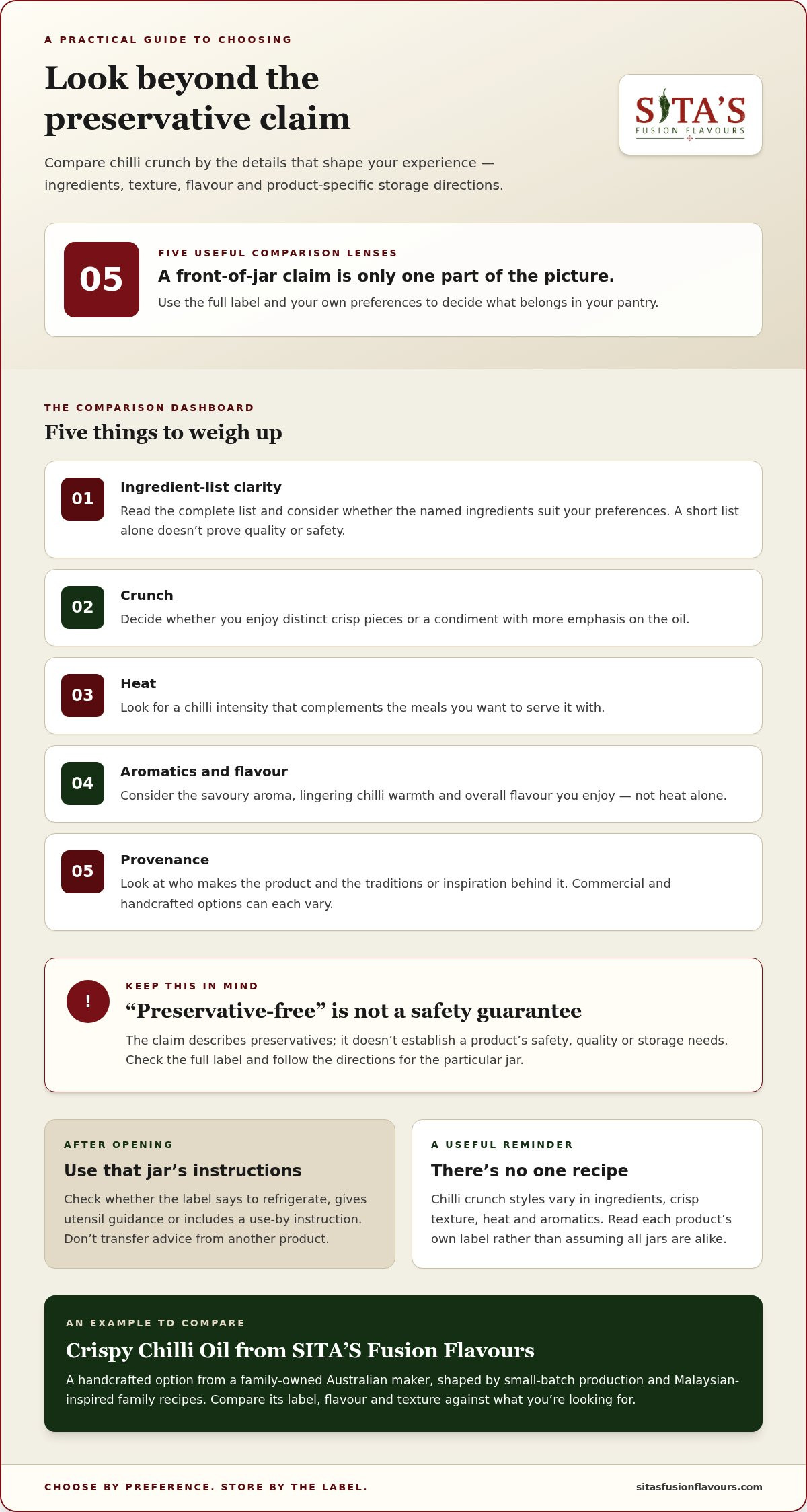
A practical checklist for choosing and using a chilli crunch alternative
A simple routine makes comparing jars easier. Decide what matters to you first, then assess ingredients and flavour before settling on an option. This keeps the choice grounded in your own preferences, rather than a single claim on the packaging.
- Identify your preferences. Note any ingredients you personally want to avoid. There’s no one ingredient list or diet that suits everyone.
- Read the full ingredients. Check the product’s stated composition and consider whether it matches your preferences.
- Compare the sensory qualities. Think about how much crunch, chilli intensity and aromatic character you want in your meals.
- Check the directions. Look for clear storage and use instructions before choosing, then follow them once the jar is open.
What questions should guide your shortlist?
Ask yourself: does the ingredient list suit what I’m looking for? Will the texture work with the meals I cook? Does the chilli character sound enjoyable rather than overpowering? Finally, can I find the product’s storage and use directions? These questions help you compare a preservative free alternative to commercial chilli crunch brands on practical details as well as personal preference.
How can you serve chilli crunch with confidence?
Start with a small amount, taste, then add more if you’d like extra heat, fragrance or crunch. A spoonful can bring texture to noodles or rice, add a savoury lift to dumplings, or give eggs a spicy finish. The right amount depends on the condiment’s character and your palate, so let the first taste guide you.
For another way to bring chilli oil to the table, try this Malaysian chilli oil laksa recipe for meal inspiration. Whether you’re dressing a quick bowl of rice or adding a finishing touch to a leisurely meal, choose a condiment whose flavour and texture complement the dish. Then keep it according to its own directions.
For a handcrafted chilli condiment, see SITA’S Crispy Chilli Oil, made in small batches and inspired by Malaysian flavours and family recipes.
Discover a handcrafted chilli oil alternative from SITA'S
If you’re considering a preservative free alternative to commercial chilli crunch brands, a handcrafted condiment offers another way to explore chilli flavour and texture. SITA’S Crispy Chilli Oil is a handcrafted chilli condiment made in small batches by a family-owned Australian business. Its Malaysian-inspired heritage and family recipes bring a maker-led story to the pantry, without making broad claims about what’s best for every shopper.
SITA’S uses Australian-sourced ingredients across its handcrafted chilli oils and condiments. To assess Crispy Chilli Oil for your needs, read its ingredient and storage information. That lets you consider the product’s stated composition and directions without assuming that handcrafted means preservative-free or that a particular shelf life applies.
What makes a handcrafted alternative worth exploring?
Small-batch making gives a family maker room to bring care and a distinct flavour perspective to a condiment. At SITA’S, that perspective is shaped by Malaysian-inspired flavours and family recipes passed down through generations. It’s a reason to explore the product as a crafted pantry option, not a promise of superiority. For more on how small makers approach condiments, read the artisan pantry guide.
The appeal can be wonderfully everyday: a chilli condiment that brings flavour and crisp texture to a meal, whether you’re dressing a simple bowl or adding a finishing touch at the table. Let your own taste decide how it fits your cooking.
Where can SITA'S chilli oil fit in your pantry?
Think of Crispy Chilli Oil as an option for adding chilli flavour and texture to meals. Read its ingredient information to see whether it suits your preferences, and follow the product’s storage directions. That’s a practical way to make room for a handcrafted condiment while keeping its own guidance in view.
See SITA’S handcrafted chilli oils to learn more about the family’s flavour-led approach to the pantry. A good fit is the one whose stated ingredients, texture and chilli character work for you, and whose directions you can follow with confidence.
Choose your next chilli crunch with confidence
The right jar is about more than a preservative-free claim. Compare the full ingredient list, the crunch and chilli character you enjoy, and the product’s own storage directions. A preservative free alternative to commercial chilli crunch brands is a personal preference, not a shortcut to judging safety or quality.
For a handcrafted option, SITA’S Crispy Chilli Oil brings chilli flavour and texture to the table. It’s made in small batches by a family-owned Australian business, with Malaysian-inspired flavours, family recipes and Australian-sourced ingredients at the heart of its approach. Read the product information to decide whether it suits your preferences and pantry.
Explore SITA'S handcrafted chilli oils and choose a flavour for your everyday meals.
Frequently Asked Questions
Is preservative-free chilli crunch automatically healthier?
No. A preservative-free claim doesn’t establish a product’s overall nutritional value or guarantee a particular health outcome. It describes one aspect of the product. Compare the full ingredient list and nutrition information with your own preferences, including any ingredients you choose to avoid. For food safety and storage, follow the product’s specific directions rather than assuming that the absence of a preservative makes a condiment safer.
Can chilli crunch be made without preservatives?
Yes, recipes and production methods vary, so the answer depends on the specific product. Don’t infer a condiment’s formulation from its appearance, style or marketing language. Read its ingredient information and follow the storage directions supplied with it. If you’re making chilli oil at home, use reliable food-safety guidance for the recipe and ingredients. Don’t assume a homemade condiment is shelf-stable without clear, trustworthy instructions.
How can I tell whether a chilli crunch contains preservatives?
Read the complete ingredient list and relevant packaging information, rather than relying only on front-of-pack wording. Some ingredient names may be unfamiliar, and a single claim won’t explain the whole recipe or how the product should be stored. If a particular ingredient matters to you, assess the product information against your own needs and preferences. Check the storage directions separately, as ingredients alone don’t tell you how to handle the jar.
What should I look for in a preservative-free chilli oil alternative?
Start with the full ingredient list and the product’s storage directions. Then consider the qualities you enjoy: crisp texture, chilli intensity, aromatic flavour and how you plan to use the condiment. The best preservative free alternative to commercial chilli crunch brands is one that suits your preferences and comes with directions you can follow. Don’t treat a single front-label claim as a guarantee of quality or safety.
Does preservative-free chilli oil need refrigeration?
There isn’t one storage rule that applies to every chilli oil or chilli crunch product. Ingredients, preparation and packaging can differ, so follow the instructions on the specific product, including any directions for after opening. Don’t rely on a general online timeframe or assume a condiment is shelf-stable because its appearance or smell seems unchanged. If the label provides storage guidance, use that rather than advice for a different jar.
What is the difference between chilli oil and chilli crunch?
Chilli oil generally describes an oil-based condiment flavoured with chilli, while chilli crunch usually signals crisp inclusions that add texture. The terms can overlap, and recipes vary between makers. Check the ingredient information and consider the product’s texture and flavour notes to decide which style suits your meals. A name alone may not tell you how crunchy, aromatic or hot a particular condiment will be.
Is small-batch chilli oil a good alternative to commercial chilli crunch?
It can be a good fit if you’re drawn to a maker-led condiment and distinctive flavour, but small-batch production alone doesn’t prove a product is preservative-free or determine its storage needs. Compare the product information, texture and heat with your preferences. SITA’S makes handcrafted chilli oils in small batches, using Australian-sourced ingredients and family recipes, with Malaysian-inspired flavours. Read each product’s ingredient and storage information to decide if it suits your pantry.