
Crunchy Chilli Condiment vs Traditional Sambal Oelek: The Ultimate Pantry Showdown
·
SITA'S Fusion Flavours
Your favourite stir-fry doesn't need more heat; it needs the right kind of soul. It's far too easy to feel overwhelmed standing in the condiment aisle, staring at a wall of vibrant red jars that all promise a similar kick. You've likely grabbed a generic, mass-produced oil only to find it lacks any real depth. Or perhaps you've accidentally ruined a delicate silken tofu dish by using a condiment with a texture that simply didn't belong. It's a common kitchen frustration. Understanding the nuances of a crunchy chilli condiment vs traditional sambal oelek is the secret to transforming a simple meal into a sensory masterpiece.
We'll guide you through the fundamental differences in texture, aroma, and culinary application between these two heavyweights. You'll learn how the oil-rich, umami-dense crunch of modern infusions compares to the raw, sharp, and clean heat of a time-honoured sambal. We'll provide the confidence you need to pair these condiments with specific dishes, moving beyond guesswork toward intentional, handcrafted flavour. By the end, you'll know exactly which jar to reach for to elevate your home cooking with authentic, artisan quality that honours legacy while embracing bold innovation.
Key Takeaways
- Discover the fundamental structural divide between a crunchy chilli condiment vs traditional sambal oelek, helping you choose between an oil-rich finishing touch and a raw, acid-driven cooking base.
- Master the "Golden Rule" of culinary matchmaking: reach for sambal as a foundational flavour base and save your crispy oils for that final, sensory crunch.
- Learn how traditional handcrafted methods preserve the integrity of slow-fried aromatics, ensuring your pantry staples offer genuine depth rather than just heat.
- Identify the hidden fillers in mass-produced jars so you can invest in high-quality, Australian-made artisan options that truly elevate your home cooking.
- Gain the confidence to balance heat and texture in complex dishes like laksa, ensuring every spoonful delivers a sophisticated blend of Malaysian-inspired heritage.
Defining the Great Chilli Divide: Texture vs Tradition
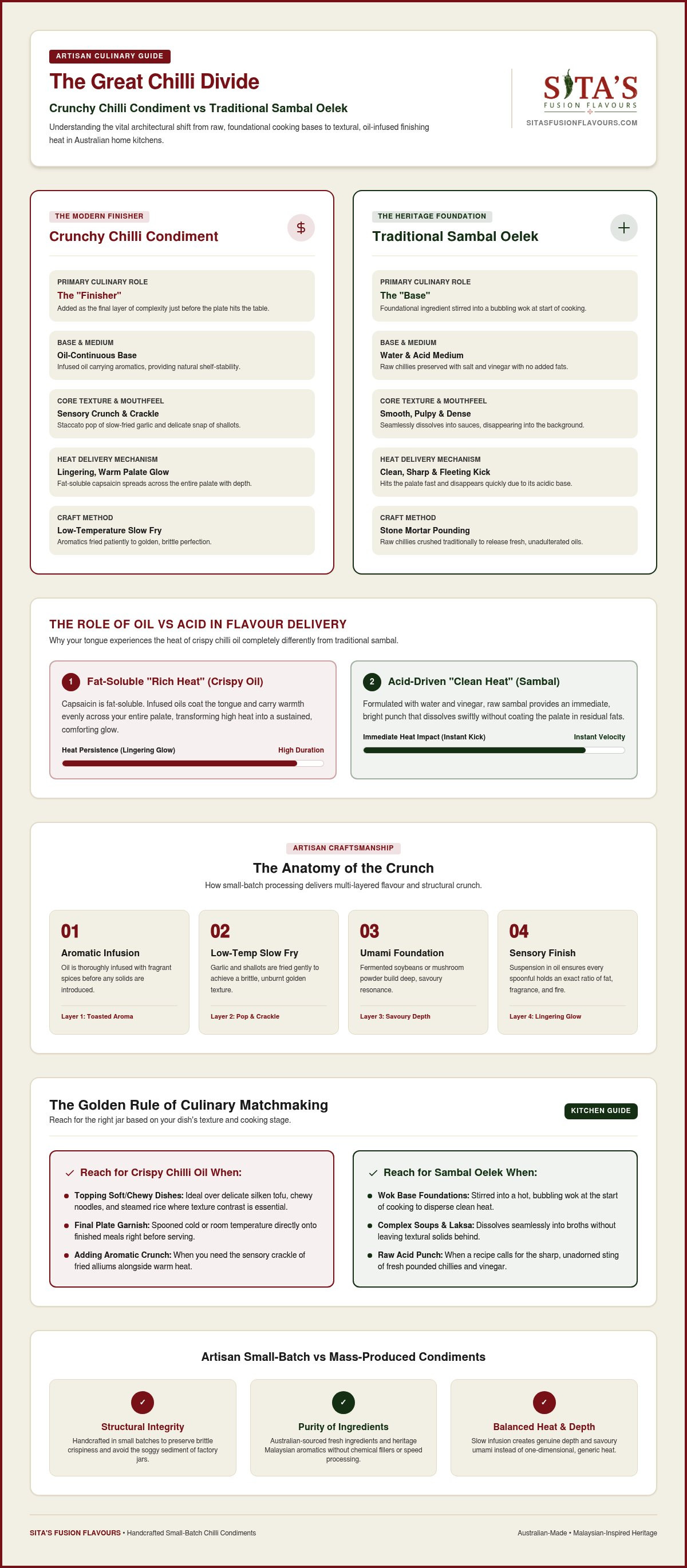
Choosing between a crunchy chilli condiment vs traditional sambal oelek isn't just about heat levels. It's about the very architecture of your meal. For a long time, Australian kitchens treated chilli as a one-dimensional spice, but the landscape has shifted. We now crave texture. We want that satisfying pop of a fried allium alongside the burn. While sambal oelek serves as a foundational "base" ingredient, often stirred into a bubbling wok at the start of cooking, a crispy chilli oil is a "finisher". It's the final layer of complexity added just before the plate hits the table.
Let's break them down. Sambal oelek is a thick, vibrant paste, traditionally made by pounding raw chillies with salt and vinegar in a stone mortar. It's bright, sharp, and unapologetically fresh. On the other side, we have the modern favourite. Understanding the origins and anatomy of chili crisp reveals a different beast entirely: an oil-infused condiment packed with slow-fried garlic, shallots, and toasted chilli flakes. It's rich, savoury, and designed for shelf-stability through its oil-continuous base. The choice between a crunchy chilli condiment vs traditional sambal oelek often dictates whether your dish feels like a quick home meal or a restaurant-quality experience.
The Role of Oil in Flavour Delivery
Oil acts as a vehicle. Because capsaicin is fat-soluble, the infused oil in our Crispy Chilli Oil carries heat across your entire palate, creating a lingering, warm glow rather than a sharp, fleeting sting. Traditional sambal offers a "clean" heat. It hits fast and disappears quickly because of its water and acid base. Infused oils provide a "rich" heat that stays with you. The suspension of ingredients in oil also ensures every spoonful is a perfect ratio of fat, fragrance, and fire.
Mouthfeel: The Secret Ingredient
Texture is the new frontier. A traditional oelek is smooth, pulpy, and dense. It integrates seamlessly into sauces, disappearing into the background while providing a flavour backbone. A crunchy condiment does the opposite. It demands attention. You get the staccato crackle of fried garlic and the delicate snap of shallots. These textures create a beautiful contrast when drizzled over soft foods like silken tofu or chewy noodles. It's about the sensory experience of the "crunch" that turns a simple bowl of rice into something memorable.
The Anatomy of the Crunch: Why Crispy Chilli Oil is Trending
The Australian culinary scene has undergone a spicy metamorphosis. We've moved beyond the singular burn of bottled hot sauce and embraced the complex, multi-sensory world of the "chilli crisp". This isn't just a pantry trend; it's a fundamental shift in how we experience heat. Unlike a traditional Southeast Asian sambal, which relies on the raw punch of the pepper, crispy chilli oil is a masterpiece of infusion and texture. The secret lies in the slow-fry. We meticulously fry garlic and shallots at low temperatures until they reach a golden, brittle perfection. This process requires patience. It's a craft that mass-produced brands often skip in favour of chemical additives and high-speed processing.
To achieve a truly premium crunchy chilli condiment vs traditional sambal oelek, the oil itself must be the star. We don't just mix flakes into oil; we infuse the oil with aromatics first. This ensures every drop carries the essence of toasted spices before the solids are even added. Depth comes from umami. By incorporating ingredients like fermented soybeans or mushroom powder, we create a savoury foundation that lingers. This is what separates a generic oil from a handcrafted essential. A well-made oil should have layers. It begins with the aroma, followed by the initial crunch, and ends with a deep, savoury glow that makes you want to go back for a second spoonful.
The SITA'S Approach to the Crunch
Our philosophy focuses on the "maker-to-consumer" intimacy. We use small batch chilli oil techniques to ensure the structural integrity of every crispy bit. High-volume manufacturing often results in soggy sediment. By keeping our production small, we preserve that vital "pop" and "crackle". We balance this sizzle with heritage-inspired Malaysian aromatics, using Australian-sourced ingredients that provide a freshness you can actually taste. It's about honouring our roots while using the best of what our local soil offers. This dedication to quality is why the debate of a crunchy chilli condiment vs traditional sambal oelek often comes down to the quality of the ingredients used.
Beyond Heat: Flavour Layers
A premium condiment should offer more than just a tongue-numbing experience. Our kaffir lemongrass chilli oil Australia range proves that "crispy" can also be bright and citrusy. We carefully balance salt and sugar to enhance the natural sweetness of the fried alliums. This creates a sophisticated profile where the heat is a companion, not a bully. You don't need to blow your head off to enjoy a bold meal. Instead, look for a balance that elevates the other ingredients on your plate. If you're ready to transform your pantry, you might find your new kitchen staple in our handcrafted range.
Sambal Oelek: The Raw, Fermented Soul of Southeast Asia
To understand the soul of a Southeast Asian kitchen, you must look at the stone mortar. The term 'Oelek' (properly ulek) refers to the ulekan, a stone pestle used to grind ingredients on a flat cobek stone. This isn't just a naming quirk; it's a description of the condiment's very nature. While a crunchy chilli condiment vs traditional sambal oelek debate often focuses on the modern "crunch", the oelek represents a purity of flavour that has sustained generations. It is a raw, vibrant paste built on a foundational trio: fresh red chillies, coarse sea salt, and a sharp acid like vinegar or lime juice.
Unlike the oil-continuous emulsions found in crispy oils, traditional sambal oelek is water and acid-based. This creates a clean, bright heat that hits the palate with immediate intensity. While the oelek itself is raw and fresh, the broader Southeast Asian sambal tradition often leans into fermentation, using ingredients like shrimp paste to create a "funk" and depth that oil-based condiments lack. This creates a complex profile where the heat is supported by a deep, savoury backbeat. It lacks the heavy, toasted fats of an infused oil, offering instead a sharp clarity that highlights the quality of the chillies themselves. This makes it an essential tool for those who value the "maker-to-consumer" intimacy of raw, unadulterated ingredients.
A Foundational Cooking Ingredient
In Malaysian and Indonesian homes, sambal oelek is the 'salt and pepper' of the kitchen. We don't just use it as a side; it's a workhorse. It serves as the primary base for marinades and stir-fry sauces, integrating into the liquid components of a dish without adding excess oil. It's important to distinguish it from its cousins: Terasi, which adds the pungent depth of fermented shrimp paste, or Bajak, which is a richer, cooked version. Oelek remains the minimalist choice, providing a versatile heat that doesn't overwhelm the other aromatics in your wok.
The Brightness Factor
The defining characteristic of a superior sambal is its acidity. This vinegar or lime component is a culinary laser. It cuts through the heaviness of fatty meats like pork belly or duck, providing a necessary counterpoint to rich flavours. If you've ever found a soup or stew tasting a bit "flat" or dull, a teaspoon of oelek is the superior choice for brightening the entire profile. Choosing between a crunchy chilli condiment vs traditional sambal oelek often comes down to this: do you need the rich, toasted depth of oil, or the sharp, lifting clarity of acid? Because of this high-acid environment, oelek also boasts a robust shelf-life, remaining a reliable, sharp presence in your fridge.
Culinary Matchmaking: When to Reach for the Jar
Mastering the kitchen requires more than just heat; it requires an understanding of how textures interact with your ingredients. If you've ever wondered about the best use for a crunchy chilli condiment vs traditional sambal oelek, follow the Golden Rule: use sambal for the cooking process and save your crunchy oil for the finish. This simple distinction prevents you from losing that vital "pop" in a hot wok or ending up with oily residue where you want a clean, acidic lift. Using a crunchy oil in a long-simmering stew is often a waste, as the fried garlic loses its brittle snap and becomes soggy sediment. Conversely, a matte sambal on a fried egg can feel too sharp and one-dimensional compared to the rich, toasted glow of an oil-based topper.
Complex dishes like an chilli oil laksa recipe actually benefit from both. You use a sambal base to build the foundational broth, then drizzle a premium crispy oil over the top just before serving. This creates a multi-layered experience where the heat is both integrated into the soup and textural on the surface. For a stir-fry strategy, build your aromatics with a teaspoon of sambal to coat the vegetables, then garnish with a spoonful of crisp to add that final, sensory crackle.
The Comparison Framework
When weighing up these two staples, consider the heat intensity and sensory impact. Raw sambal delivers a punchy, immediate sting that "disappears" perfectly into sauces, making it ideal for marinades where you don't want visible bits. Infused oils offer a slow-burn glow that lingers on the palate. Visually, the two couldn't be more different. One provides elegant, translucent red oil droplets that catch the light, while the other offers a rustic, matte red paste that speaks of traditional stone-ground methods. Each has its place, but they are rarely interchangeable if you value the structural integrity of your meal.
Specific Pairings for the Australian Table
For the classic Sunday Barbie, reach for the sambal oelek to marinate your grilled prawns or steak. Its acidity tenderises the meat while providing a clean background heat. On dumpling night, however, the crunchy oil is king. It creates the ultimate dipping sauce when mixed with a little black vinegar, clinging to the dough with every crispy fragment. Even a quick mid-week meal of instant noodles or avocado toast is instantly elevated. A single spoonful of our Crispy Chilli Oil transforms simple eggs into a restaurant-quality breakfast. If you're ready to master these flavour profiles, you can start by trying our authentic laksa guide to see this balance in action.
Beyond the Supermarket Aisle: Why Small-Batch Quality Wins
Stepping away from the fluorescent lights of the supermarket aisle opens up a world of genuine craftsmanship. Mass-produced jars often rely on fillers, industrial preservatives, and cheap, highly processed oils to keep costs down. These shortcuts sacrifice the very soul of the product. When choosing a crunchy chilli condiment vs traditional sambal oelek, the artisan difference is immediately apparent in the structural integrity of the ingredients. Handcrafted methods ensure that the 'crunch' remains a brittle, satisfying snap rather than a soggy, oil-logged disappointment. Small-batch production offers a 'maker-to-consumer' transparency that industrial giants simply can't match. You aren't just buying a jar; you're supporting the local Australian artisan economy and honouring a legacy of flavour.
Transparency is the hallmark of the passionate artisan. In a small-scale kitchen, there is no room for hidden chemicals or generic bulk ingredients. We use Australian-sourced produce because it tastes better and supports our community. This manual labour is a time-intensive process, but it's the only way to ensure the flavour intensity remains consistent. When you open a handcrafted jar, you're experiencing a product that has been nurtured from the initial infusion to the final seal, ensuring that the "how" and "why" of the business are always intertwined with the "what".
The SITA'S Fusion Flavours Difference
Our approach is rooted in a deep respect for the past. We blend Malaysian heritage with modern Australian taste profiles, ensuring each jar delivers a balanced, sophisticated heat. This consistency is only possible through small-batch production, where we can monitor every infusion with a human touch. Our masala chai Australia philosophy of 'slow and soul' extends directly to our chilli oils. We don't rush the process. We value quality over quantity, treating every batch as a kitchen essential rather than a commodity. It's a nurturing process that results in a daringly intense flavour profile.
Your Pantry, Reimagined
The mark of a modern cook is a well-curated 'library' of condiments. You don't have to choose between a crunchy chilli condiment vs traditional sambal oelek; you simply need to understand their unique roles. To maintain that perfect, sensory crackle in your oils, store them in a cool, dark pantry away from the heat of the stove. Always use a clean, dry spoon to prevent contamination and preserve that vital texture. The final verdict is simple: use your sambal to build the fire and your crispy oil to provide the light. By embracing both, you reimagine your pantry as a toolkit for bold, innovative, and authentic home cooking.
Master the Art of the Australian Pantry
Deciding between a crunchy chilli condiment vs traditional sambal oelek transforms your cooking from a routine task into a sensory exploration. You now know that sambal provides the sharp, acidic foundation needed for marinades and slow-cooked bases; meanwhile, a premium crispy oil delivers that final, textural crackle that brings a dish to life. It's about respecting the heritage of the recipe while embracing the bold innovation of modern infusions. By choosing artisan quality over mass-produced alternatives, you ensure every meal is backed by the integrity of small-batch craftsmanship.
Our oils are handcrafted with heritage recipes, using Australian-sourced ingredients to create sensory-rich infusions that honour our Malaysian roots. We invite you to explore the SITA'S range and find your perfect crunch today. Whether you're brightening a mid-week soup or perfecting your Sunday breakfast, the right jar makes all the difference. Fire up your wok, trust your palate, and enjoy the journey of discovering your new favourite kitchen essential. Happy cooking!
Frequently Asked Questions
Can I use sambal oelek as a substitute for crunchy chilli oil?
You can substitute them in terms of heat, but the structural result will differ significantly. Sambal oelek is a wet, acidic paste that integrates into sauces, while a crunchy chilli condiment adds a brittle, toasted texture. If you use sambal as a topper for avocado toast, you'll miss the "pop" of fried alliums. Conversely, using a crunchy oil as a marinade base might add too much oil to your recipe.
How long does a handcrafted crunchy chilli oil last in the pantry?
A handcrafted jar typically maintains its peak flavour and texture for six to twelve months when stored in a cool, dark place. Because we use small-batch methods and Australian-sourced ingredients without heavy industrial preservatives, the aromatics stay vibrant longer. Always ensure you use a clean, dry spoon to prevent moisture from entering the jar, as this is the primary way to preserve the structural integrity of the "crunch".
Is crunchy chilli condiment hotter than traditional sambal oelek?
Heat levels vary wildly depending on the specific peppers used in the infusion. While traditional sambal oelek usually offers a consistent, medium-raw burn, our range includes options like Ghostly Chilli Oil and Carolina Reaper Chilli Oil for those seeking extreme intensity. When comparing a crunchy chilli condiment vs traditional sambal oelek, the oil version often feels like a slower, more lingering glow because the fat carries the heat across the palate.
Do I need to refrigerate my chilli oil after opening?
Refrigeration isn't strictly required for oil-based condiments, but it can help extend the life of the delicate aromatics in the Australian heat. If you do keep it in the fridge, the oil may solidify or become cloudy. Simply let the jar sit at room temperature for a few minutes before use to restore its fluid consistency. Keeping it in a dark pantry away from the stove is usually sufficient for daily use.
What makes a chilli oil 'Malaysian-inspired' compared to Chinese versions?
Malaysian-inspired oils often lean into a unique profile of citrusy and herbal aromatics that differ from the fermented bean or Sichuan peppercorn focus of Chinese styles. At SITA'S, we use heritage family recipes that incorporate kaffir lime and lemongrass to create a bright, fragrant depth. This creates a sophisticated balance where the heat is supported by a refreshingly zesty undertone, reflecting the diverse flavour landscape of Malaysian soul food and heritage.
Can I use these condiments if I have a low spice tolerance?
Absolutely, you can still enjoy the depth of these flavours by being selective with your portioning. If you're wary of heat, try drizzling just the infused oil without the sediment, or start with a milder variety like our Aji Limon Chilli Oil. The goal isn't always to find the hottest burn; it's about the sensory experience of the aromatics. A tiny drop can elevate a dish without overwhelming your taste buds.
Are SITA'S Fusion Flavours products vegan and gluten-free?
We pride ourselves on using clean, Australian-sourced ingredients and traditional handcrafted methods. While many of our infusions are made with plant-based ingredients and contain no added gluten, we always recommend checking the specific label on your jar for a full ingredient list. Because we produce in small batches, we maintain high transparency about what goes into every recipe, ensuring you know exactly what you're bringing into your family kitchen.
What is the best way to use the leftover oil once the crunchy bits are gone?
The infused oil is a liquid gold that shouldn't be wasted once the crispy bits are finished. Use it as a base for a spicy vinaigrette, drizzle it over steamed greens, or use it to fry your morning eggs for an instant flavour boost. It carries the essence of the slow-fried garlic and shallots, making it a versatile kitchen essential even without the texture. It's the perfect way to ensure every drop of your crunchy chilli condiment vs traditional sambal oelek investment is used.