
Boutique Chilli Crisp Alternatives: What to Look For
·
SITA'S Fusion Flavours
What makes a boutique jar worth choosing over a supermarket favourite? Not the word “artisan” on the label, but the flavour you enjoy, the crunch you want and what you can learn about who made it. If shelf choices feel much the same, comparing boutique alternatives to supermarket chilli crisp brands can help you find a jar that suits your table.
It’s reasonable to want more than an appealing product description. You want useful details about texture, ingredients and heat, plus a maker story that’s clear rather than vague. This guide shows you how to compare chilli crisp options using practical clues, so you can make a considered choice instead of relying on packaging alone.
We’ll look at flavour, crunch, ingredient information and maker transparency, including what to check before ordering online in Australia. SITA’S Fusion Flavours is a family-owned Australian business making Malaysian-inspired condiments in small batches, with family recipes and Australian-sourced ingredients. Its Crispy Chilli Oil is one option for shoppers drawn to a crunchy chilli condiment. The best fit depends on what you want from a jar and how you plan to use it.
Key Takeaways
- “Boutique” describes a small-maker category, not a guarantee of better quality. Judge each jar on the information provided and what you enjoy.
- Use the same checklist for boutique alternatives to supermarket chilli crisp brands: look for clear guidance on crunch, aroma, flavour balance and heat.
- Match your choice to the meals you make, the texture you like and the product details you need before buying.
- A maker’s story can provide useful context, but it isn’t proof of superiority. SITA’S Fusion Flavours makes Malaysian-inspired condiments in small batches using Australian-sourced ingredients and recipes passed down through generations.
- For a crunchy option, consider SITA’S Crispy Chilli Oil and check its current product and ingredient information before ordering.
Boutique chilli crisp alternatives: what shoppers are really comparing
A familiar jar can be an easy choice. But perhaps you’re after a different kind of crunch, a flavour that adds character to a meal, or a condiment that better suits your cooking. Looking for boutique alternatives to supermarket chilli crisp brands is about discovering options, not declaring supermarket products inferior.
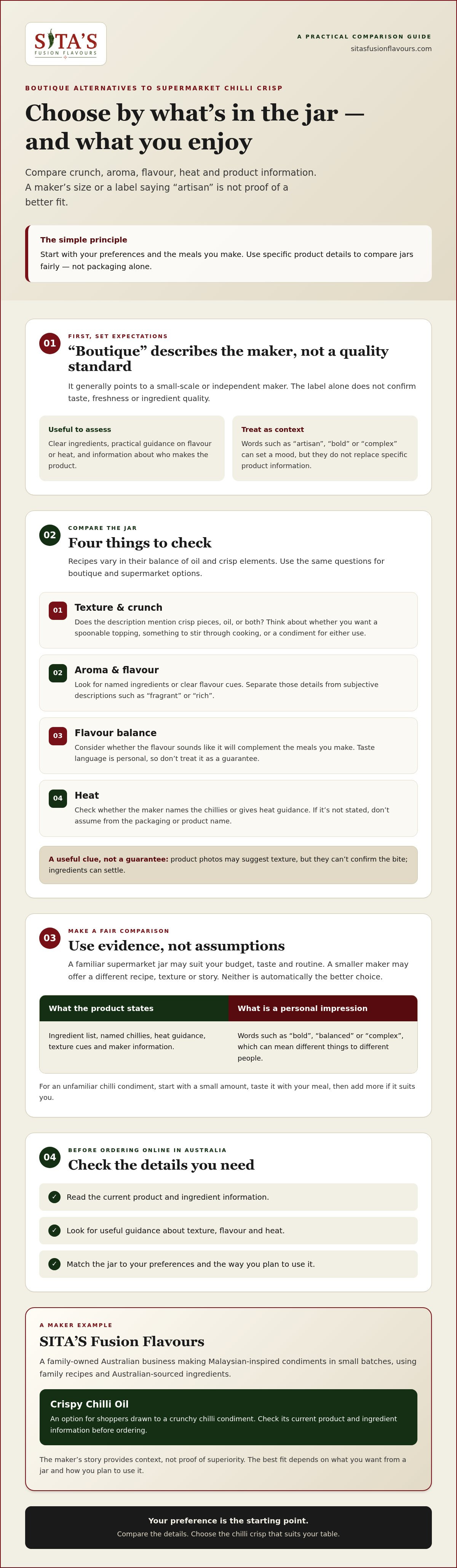
Chili crisp is a broad condiment category, and jars can vary in their balance of oil and crisp elements. Compare the details that affect how you’ll use a product: texture, aroma, flavour, heat, ingredients, maker information and suggested uses. A useful comparison starts with your preferences, not the maker’s size.
What does boutique chilli crisp mean?
“Boutique” generally points to a small-scale or independent maker, rather than a specific recipe or recognised quality standard. A maker might share details about how a condiment is produced or what inspired it, but the label itself doesn’t confirm taste, freshness or ingredient quality.
Look for specifics you can assess: a clear ingredient list, useful guidance about flavour or heat, and an explanation of who makes the product. Words such as “artisan” can set a mood, but they’re no substitute for practical product information. Treat the maker’s story as context, then decide whether the jar sounds right for you.
Why look beyond familiar supermarket options?
A familiar supermarket jar may suit your budget, taste and everyday cooking routine. Exploring smaller makers gives you another path to a condiment with a different recipe, texture or story. Those differences aren’t guaranteed by the maker’s size, so check the details instead of assuming every boutique option will be distinctive.
Start by deciding what you want to change. Are you looking for a more noticeable crunch, clearer ingredient information or a flavour direction that complements the meals you make? Product descriptions can help, but separate stated facts, such as listed ingredients, from subjective language such as “bold” or “complex”. The next sections explain how to compare crunch, aroma, flavour and heat, then assess product information and intended use across supermarket and boutique jars.
Compare chilli crisp by crunch, aroma, flavour and heat
A jar can look inviting, but its product details tell you more about how it may work on your plate. Chilli crisp is a chilli condiment whose texture and flavour vary by recipe. Use the checklist below to compare options, including boutique alternatives to supermarket chilli crisp brands, against your own preferences rather than a maker’s claims alone.
How to judge texture and aroma
Texture depends on the balance of oil and crisp pieces, along with any other solids in the recipe. A description that mentions pieces or crunch may indicate a more textured spoonful; one that focuses on oil may suggest a different way to drizzle or mix it. Treat product photos as clues only. Ingredients can settle, and an image can’t confirm the texture of a bite.
Think about how you’ll use the jar. Do you want a spoonable topping for a finished meal, an ingredient to stir through cooking, or something that may work both ways? Aroma matters, too. Look for concrete details about ingredients or preparation, while remembering that words such as “fragrant” describe an impression rather than a measurable feature.
How much heat and flavour suits your palate?
Heat is only one part of flavour. A hotter condiment isn’t automatically a better match: you may prefer a gentler lift or a taste that complements the rest of the dish. If a maker names the chillies used or provides heat guidance, use that as a comparison point. If those details aren’t stated, don’t assume them from the packaging or product name.
Separate information you can verify from tasting language. An ingredient list names what’s included; phrases such as “rich”, “balanced” or “bold” are subjective and can mean different things to different people. For an unfamiliar chilli condiment, start with a small amount, taste it with the meal, then add more if it suits you.
- Texture: Does the description indicate crisp pieces, oil, or both?
- Aroma and flavour: Are specific ingredients or flavour cues stated, or is the wording mainly evocative?
- Heat: Is there clear guidance, or will you need to start cautiously?
- Use: Does the product seem suited to topping, cooking, or either, based on the maker’s directions?
For a real-world comparison, check the product information for SITA’S Crispy Chilli Oil against the same checklist. Focus on what the maker states, and avoid assumptions about flavour or heat that the product information doesn’t confirm.
Boutique versus supermarket chilli crisp: a fair comparison framework
A supermarket jar and a small-maker jar can both earn a place in your pantry. One may suit your regular cooking routine; another may appeal because of its recipe or maker story. Compare the information and eating experience offered by each jar, rather than judging by scale.
Ask the same questions about both options. This keeps your comparison grounded in what’s actually stated, rather than assumptions about where or how a product is made.
| What to compare | Questions to ask |
|---|---|
| Product information | Are serving suggestions, storage instructions and other practical details provided? |
| Ingredients and allergens | Can you find the ingredient list and allergen information, and is anything important unclear? |
| Texture | Does the description explain the balance of oil and crisp pieces? Treat photos as clues, not proof. |
| Flavour guidance | Does the maker name specific ingredients or flavour cues, or rely mainly on subjective words such as “bold”? |
| Intended use | Is the condiment suggested as a topping, a cooking ingredient, or both? |
What to check on the label and product page
Read the ingredient list and allergen statement, then look for storage instructions and any origin claims the maker supplies. Keep stated details separate from what the branding might suggest. For example, a flag or a phrase such as “locally made” doesn’t, by itself, tell you where every ingredient comes from.
If an ingredient, allergen or storage detail matters to you and isn’t clear, contact the maker before buying. Don’t guess to fill in missing information.
What boutique makers may offer, and what to verify
Small-batch production can give a maker a closer story to share, such as who makes the condiment or how a family recipe informs it. That context may help you decide whether the product interests you, but it doesn’t prove better flavour or quality. Look for specific, checkable details about the maker, recipe or process.
Words such as “premium”, “authentic” and “handcrafted” can be appealing, but consider what they mean in practice. Does the maker explain what is made by hand or provide useful information about ingredients and intended use? Applying the same questions to supermarket and boutique options helps you find a jar that suits your preferences, budget and cooking habits without assuming one category is automatically better.
Choose a chilli crisp for your meals, preferences and pantry
Turn your comparison into a simple decision. First, decide what you want the condiment to add: chilli flavour, extra heat, a crisp bite, or a combination. Next, think about the meals you’re most likely to use it with and which product details you need before buying. This makes it easier to choose between familiar options and boutique alternatives to supermarket chilli crisp brands without being swayed by packaging alone.
Match texture and heat to how you eat
Picture the meal. Do you want a crunchy spoonful on top, chilli oil stirred through a dish, or a condiment that might work both ways? Check the maker’s stated texture and serving suggestions, then try an unfamiliar product in a simple meal before using it generously. This gives you a chance to notice how its texture and heat sit alongside the other flavours.
Laksa is one serving idea to explore. The guide to using chilli oil in laksa offers a specific starting point. If you’re curious about what small-batch production means, read the small-batch chilli oil guide, then assess each maker’s details on their own merits.
Buy online with confidence
Before placing an order, review the current ingredient list, allergen information, product description, shipping details and any handling or storage instructions supplied by the maker. Don’t fill gaps with assumptions. If information you need is missing, contact the maker and check that the details apply to the product you’re considering.
A maker’s website may offer more room than a short shelf label to explain who makes the condiment, how it’s produced and what the maker can confirm about its ingredients. Treat those details as useful evidence to consider, not an automatic mark of quality. For broader Australian small-business context, explore the Australian artisan pantry guide.
Then compare one familiar jar with one new option using the same questions: will it suit your meals, your preferred texture and heat, and the information you want from a maker? To consider a crunchy condiment from an Australian family-owned maker, explore SITA’S Crispy Chilli Oil and review its current product details before ordering.
Discover SITA’S handcrafted alternative to supermarket chilli crisp
If you’re exploring boutique alternatives to supermarket chilli crisp brands, it helps to know who’s behind the jar and what the maker is prepared to share. SITA’S Fusion Flavours is a family-owned Australian maker of handcrafted, Malaysian-inspired condiments. Its approach centres on small-batch production, Australian-sourced ingredients and family recipes passed down through generations.
Those details provide context about the maker and its provenance, but they don’t guarantee a particular taste or make the product the right choice for everyone. Use them alongside the same practical criteria you’d apply to any jar: check the product description, ingredients, allergen information, texture guidance, heat details and suggested uses. Where details aren’t provided, don’t fill in the gaps yourself.
A maker story grounded in family recipes
Family recipes connect SITA’S condiments to knowledge passed down through generations, while small-batch production and Australian-sourced ingredients offer further points to consider when comparing makers. These are specific elements of the business story, not claims about a flavour outcome. For a separate product topic, explore the Kaffir lemongrass chilli oil flavour guide.
Explore the range at your own pace
SITA’S confirmed offerings include Crispy Chilli Oil, along with the curated bundles Dad’s Crispy Trio and Dad’s Pick Three. If you’re drawn to a crunchy chilli condiment, Crispy Chilli Oil is one product to look into. Its name alone doesn’t tell you the precise texture, ingredients or heat, so check the current product description before deciding whether it suits your preferences.
Take your time comparing. Review current ingredient and allergen information, check whether the product suits the meals you have in mind, and confirm availability and shipping details before ordering. Then choose the option that best matches your preferred texture, flavour guidance and product-information needs, rather than relying on the word “handcrafted” by itself.
If you’d like to assess the range for yourself, explore SITA’S handcrafted chilli oils and compare the current product details with the criteria in this guide. A thoughtful choice starts with what’s in the jar and how you plan to use it.
Choose a jar that earns its place at your table
The best chilli crisp for you is the one that suits your palate and the way you cook, not simply the one with the smallest-batch label. Compare texture, flavour and heat, then check the ingredients, product guidance and maker details. Boutique alternatives to supermarket chilli crisp brands can offer another experience to explore, while a familiar supermarket jar may still suit your preferences and routine.
SITA’S Fusion Flavours is a family-owned Australian business making Malaysian-inspired condiments in small batches, using Australian-sourced ingredients and recipes passed down through generations. Let that story guide your curiosity, while checking current product information to decide what belongs in your pantry.
Ready to compare for yourself? Explore SITA’S handcrafted chilli oils and take your time choosing. A thoughtful spoonful can bring a new spark to an everyday meal.
Frequently Asked Questions
What is the difference between chilli crisp and chilli oil?
Chilli crisp generally includes crisp pieces alongside chilli-infused oil, while chilli oil usually puts more emphasis on the oil itself. The terms can overlap, though, and recipes vary. Check the product description and ingredient list to see what’s in the jar rather than relying on its name alone. If you’re after a crunchy topping, look for clear texture guidance from the maker.
Are boutique chilli crisp brands better than supermarket brands?
Not automatically. “Boutique” may describe an independent or small-scale maker, but it doesn’t guarantee better flavour, ingredients or quality. Supermarket jars and boutique alternatives to supermarket chilli crisp brands can each suit different tastes, budgets and cooking routines. Compare the details that matter to you, such as ingredient and allergen information, texture, flavour guidance, intended use and what the maker shares about the product.
How do I choose a chilli crisp if I do not know my heat tolerance?
Choose cautiously and start with a small amount. Check whether the maker provides heat guidance or names the chillies used, but remember that descriptions may not predict exactly how spicy it will taste to you. Try a little with a simple meal, taste it, then decide whether to add more. Avoid serving a generous spoonful until you know how the heat works for your palate.
What should I check before buying chilli crisp online in Australia?
Review the current product description, ingredient list, allergen information and any stated heat, texture or serving guidance. Check the maker’s shipping information for your destination and confirm current product availability before ordering. Look for handling or storage instructions, too. If an ingredient or other detail you need is unclear, contact the maker rather than guessing from the product name, photos or general brand claims.
Can I use chilli crisp for cooking as well as a topping?
Many chilli condiments can be used as a topping or added to a dish, but the best use depends on the particular product and the maker’s directions. Check whether the product information suggests cooking with it, serving it at the table or both. If you’re trying a jar for the first time, add a small amount to a meal and taste before using more.
How should I store chilli crisp after opening?
Follow the storage instructions on the product label or the maker’s current product information. Directions can differ between recipes, so don’t assume every jar should be stored in the same way or make up a shelf-life estimate. If the instructions aren’t clear, contact the maker for guidance specific to that product. Check the label again when you open the jar so you can follow its stated advice.
Does SITA’S Fusion Flavours ship chilli oils across Australia?
Yes. SITA’S Fusion Flavours ships across Australia through its online store. Before ordering, check the current shipping details for your destination, as delivery information and product availability should be confirmed at the time of purchase. The business is family-owned and makes Malaysian-inspired condiments in small batches using Australian-sourced ingredients and family recipes passed down through generations.