
Authentic Malaysian Chicken Curry Recipe: A Fragrant, Step-by-Step Guide
·
SITA'S Fusion Flavours
Authenticity in Malaysian chicken curry lives in the rempah, not in one untouchable recipe. An authentic Malaysian chicken curry recipe can vary from family to family, yet a carefully cooked spice paste brings the dish its unmistakable depth: warm, fragrant and rounded with coconut milk.
If your curry has ever turned out thin, harsh or muddled, the method matters as much as the ingredients. This guide explains what each aromatic contributes and how to build flavour step by step, with quantities and timings to help you cook with confidence.
We’ll focus on a Malay-style curry, where chilli, lemongrass and galangal meet a rich coconut base. It’s one expression of Malaysia’s diverse curry traditions. You’ll learn how to fry the rempah until fragrant, simmer the chicken until tender and adjust the heat without losing balance or character.
Key Takeaways
- Follow a clear method from preparing the rempah to simmering tender chicken.
- See how measured ingredients build aroma, warmth and a balanced sauce.
- Adjust the chilli to suit your taste while keeping the curry fragrant.
- Understand how this Malay-style approach fits within Malaysia’s varied curry traditions.
- Find serving ideas and practical guidance for handling leftovers safely, plus an optional chilli-oil finish.
What makes Malaysian chicken curry distinctive?
A good Malaysian chicken curry is fragrant before the first spoonful, then comforting and full-bodied at the table. This recipe follows a Malay-style approach, combining lively rempah with chicken and a rounded coconut-milk sauce. It’s one expression of kari ayam, not a claim that every Malaysian curry should taste or cook the same way.
Malaysian cooking reflects layered cultural influences, and curry traditions vary across communities and family kitchens. Ingredients, heat and texture all differ. Malaysian cuisine is a rich blend of cultural influences, which helps explain why one fixed formula can’t represent every household’s curry. In this recipe, aromatic spice, savoury depth and gentle warmth meet in a creamy sauce that brings the flavours together.
What does kari ayam mean?
Kari ayam means chicken curry in Malay. It describes a broad dish category rather than one definitive recipe, with versions shaped by local ingredients and family practice. This recipe draws on Malay curry traditions through its aromatic paste and coconut-rich finish. Other Malaysian chicken curries may use different spice combinations, cooking methods or bases.
How is Malaysian chicken curry different in flavour?
The flavour starts with rempah, a spice paste that gives the curry its fragrant backbone. Chilli brings warmth, while lemongrass and galangal add fresh, citrusy and earthy notes. Garlic and shallots build savoury depth; turmeric, cumin and coriander add colour and rounded aroma. The ingredients work together, making each mouthful layered rather than sharp or one-dimensional.
Method matters. Fry the rempah gently in oil before adding liquid, giving its raw edge time to soften and its aromas room to bloom. Look for a vivid fragrance and a paste that no longer smells raw. This early step lays down flavour that carries through the chicken and sauce as the curry simmers.
That flavour-building approach connects this curry to a broader Malaysian-inspired table, while each dish keeps its own identity. A Malaysian chilli oil laksa recipe, for example, offers a different balance of noodles, broth and chilli. Here, the goal is a savoury, aromatic curry with a gently warming finish.
In short: kari ayam is a varied family of Malaysian chicken curries. Fragrant spices and aromatics meet tender chicken in a sauce shaped by the cook’s tradition.
Build the flavour: ingredients for Malaysian chicken curry
This ingredient set makes a Malay-style curry for about four people. Fresh aromatics form the rempah, whole spices perfume the oil, and coconut milk rounds the spice into a generous sauce. The quantities below give you a clear starting point for an authentic Malaysian chicken curry recipe, with room to adjust the chilli to taste.
What goes into the rempah?
Grind these fresh ingredients and ground spices into the curry paste. They create its colour, aroma and warmth. Keep the whole spices separate to add directly to the pan.
- 6 shallots, peeled, about 150 g: bring sweet, savoury depth and body.
- 4 garlic cloves, peeled: add a rounded, savoury note.
- 25 g fresh ginger and 20 g fresh galangal, peeled: ginger gives gentle heat; galangal has a sharper, citrusy fragrance.
- 2 lemongrass stalks, tender inner parts sliced: add bright, lemony freshness.
- 2 fresh red chillies and 4 dried chillies, soaked until pliable and drained: provide warmth and red colour. Remove some seeds for a milder paste.
- 1 teaspoon ground turmeric, 2 teaspoons ground coriander, 1 teaspoon ground cumin and ½ teaspoon ground fennel: lend golden colour and rounded, warming spice.
Use a small food processor or blender, scraping down the sides as needed. Add a splash of water only if the blades need help. Aim for a thick, mostly smooth paste with a little texture, not a watery purée. With a mortar and pestle, pound the firmer ingredients first, then work in the chillies and ground spices.
Keep these whole spices separate: 1 cinnamon stick, 2 star anise and 3 cardamom pods. They release a sweet, warm fragrance into the cooking oil, adding another layer beyond the ground spices.
Choosing chicken, coconut milk and aromatics
Bone-in chicken gives the sauce savoury depth as it simmers. Boneless thigh cooks faster and is easier to serve. For this version, gather:
- 1 kg bone-in chicken thighs, skin removed: stay succulent through simmering.
- 2 tablespoons neutral oil and 1 sprig curry leaves: carry the spices and add a fresh, herbal aroma. Curry leaves are distinct from lemongrass, so don’t substitute one for the other.
- 400 ml coconut milk and 250 ml water: make a creamy, spoonable sauce. Coconut milk suits this recipe’s Malay-style direction, though it isn’t required in every Malaysian curry.
- 1 tablespoon tamarind paste, 1 teaspoon sugar and 1 teaspoon salt: balance richness with gentle tang, sweetness and savouriness.
If galangal is difficult to find, use extra ginger, knowing the result will be warmer and less citrusy. Chilli oil is an optional finish, not a curry ingredient. A few drops of Kaffir Lemongrass Chilli Oil can add extra heat and a fragrant flourish at the table.
How to cook authentic Malaysian chicken curry, step by step
Give the rempah time to bloom and the chicken a steady, gentle simmer. These steps turn the ingredients into a fragrant curry rather than a thin sauce with raw-tasting spice. Allow about 20 minutes to prepare, then roughly 55-65 minutes to cook, depending on your pan and the size of the chicken pieces.
Fry the rempah until fragrant
Use a heavy-based saucepan or deep frying pan large enough to hold the chicken in one layer. Keep the heat moderate and stir often. The paste should sizzle gently, not spit or catch. Its raw, sharp smell will mellow into a rounded fragrance as the colour deepens slightly. If it browns too quickly, lower the heat and add a small splash of water.
- Prepare the ingredients, about 20 minutes. Blend or pound the shallots, garlic, ginger, galangal, lemongrass, chillies and ground spices into a thick paste. Pat the chicken dry. Measure out the coconut milk, water, tamarind, sugar and salt.
- Perfume the oil, 1-2 minutes. Warm the oil in the pan over medium heat. Add the cinnamon, star anise and cardamom, stirring until fragrant. Add the curry leaves carefully, as they may splutter, and stir briefly.
- Cook the rempah, 8-10 minutes. Add the paste and stir continuously at first, then frequently as it softens. Scrape the base and corners of the pan so nothing sticks. It’s ready when it smells mellow and aromatic rather than raw, and looks thick and glossy. Don’t let it scorch.
- Coat the chicken, about 5 minutes. Add the bone-in chicken thighs and turn them until coated all over. Cook, stirring gently, until the outside loses its raw appearance and the paste clings to the pieces. This helps the chicken take on the spice before the sauce goes in.
- Add the liquid and simmer, 35-45 minutes. Pour in the coconut milk and water, then stir in the tamarind, sugar and salt. Bring just to a gentle simmer, reduce the heat and partially cover the pan. Turn the chicken occasionally. Avoid a hard boil, which can make the sauce greasy or cause the coconut milk to separate.
- Check and finish. Test the thickest part of a thigh with a food thermometer, avoiding the bone. It should reach 75°C. If the chicken is cooked but the sauce is too loose, simmer uncovered for a few minutes. Taste and adjust the salt, tamarind or sugar in small amounts.
The short sequence: fry the whole spices, soften the rempah, coat the chicken, add coconut milk and water, then simmer gently until the chicken reaches 75°C and the sauce is rich and spoonable. That’s the flavour-building rhythm at the heart of this authentic Malaysian chicken curry recipe.
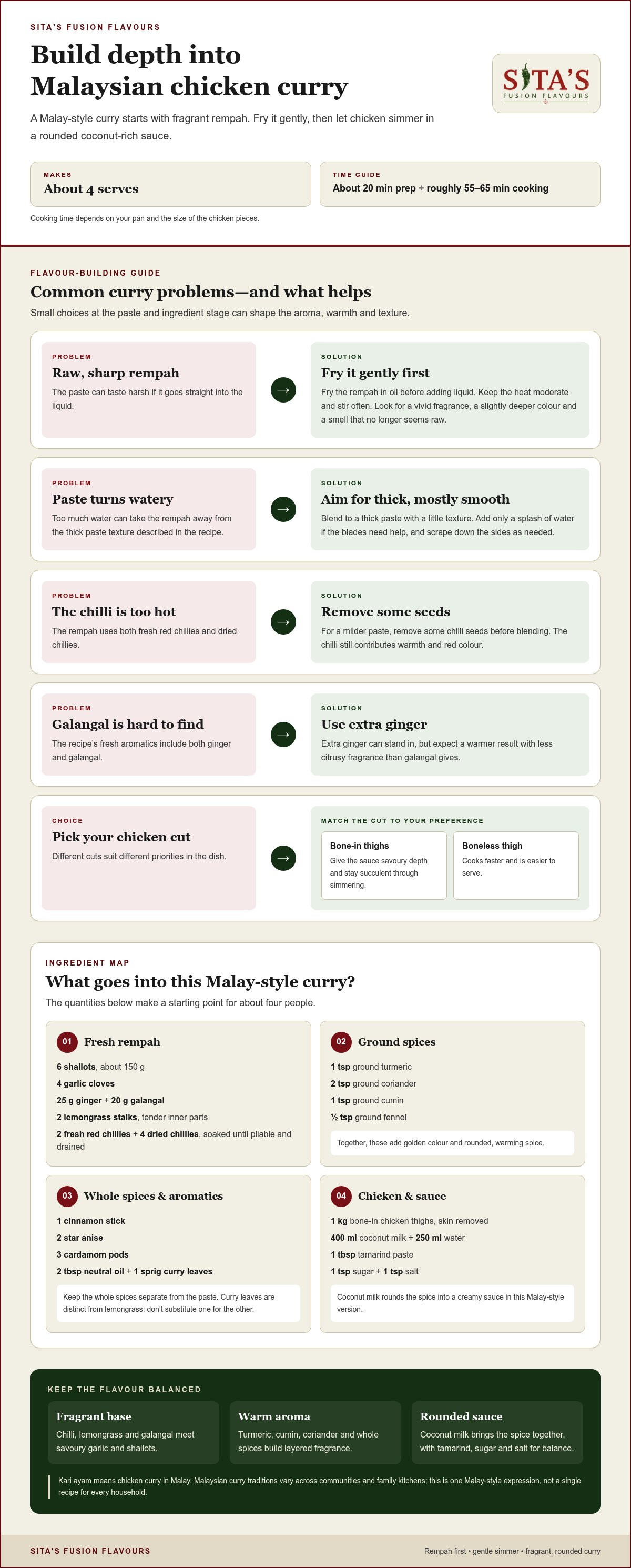
Choose your curry style and solve common cooking problems
The recipe above makes a Malay-style, coconut-rich chicken curry, but it isn’t a template for every Malaysian kitchen. A lighter sauce or sharper chilli kick is a personal adjustment, not a reason to claim that one version represents all Malaysian curry traditions. Keep the aromatic base balanced, then tune the sauce to suit your table.
Coconut-rich, lighter and hotter variations
For a fuller, creamier finish, keep the recipe’s 400 ml coconut milk and reduce the water slightly. Let the sauce simmer gently until it coats a spoon. For a lighter variation, try 300 ml coconut milk with 350 ml water. The sauce will taste less creamy, so simmer uncovered near the end if it needs to thicken. These are adjustments to this recipe, not fixed rules for Malaysian curry.
Chilli heat is easier to add than remove. For a milder pot, use two dried chillies instead of four while keeping the lemongrass, galangal and other aromatics as written. For more warmth, add one extra soaked dried chilli to the rempah, or taste the curry as it simmers and add a little more gradually. The paste’s heat will mellow and spread through the sauce as it cooks. A drizzle of chilli oil at the table is another optional way for each person to add heat.
Why can curry sauce taste thin, oily or bitter?
Small corrections can bring the flavours back into balance. Check the cause before adding anything, and change one thing at a time so you can taste the effect.
- Thin sauce: check that you’ve used the stated amounts of coconut milk and water. If the chicken is cooked and the sauce still runs freely, simmer uncovered for a few minutes, stirring gently. Avoid adding flour or other untested thickeners, which can muddy the texture and flavour.
- Oily sauce: a little surface oil can appear as the curry cooks. Lower the heat if the sauce is bubbling hard, then spoon off excess oil if you prefer a leaner finish. Stir gently to bring the sauce together again.
- Bitter or harsh flavour: the rempah may have caught on the pan or browned too quickly. Scorched paste can’t be fully rescued, so keep the heat moderate and stir often from the start. If the curry is sharp rather than burnt, simmer gently for a little longer and taste again.
- Flat flavour: add salt in small pinches, tasting after each addition. If it needs lift, stir in a little extra tamarind; if the tang feels too pointed, balance it with a small pinch of sugar.
Authenticity isn’t a test of whether you’ve followed one immutable formula. An authentic Malaysian chicken curry recipe can reflect a particular family or regional approach. Describe your changes honestly as your own variation. For a brighter, hotter finish, explore chilli oils for an optional finishing drizzle, then let everyone season their serving to taste.
Serve, store and enjoy Malaysian chicken curry
Bring the curry to the table while the sauce is glossy and fragrant, with something simple alongside to catch every spoonful. Rice is a natural match: its mild flavour lets the spice shine, and the grains soak up the coconut-rich sauce. For a change, serve it with roti or another flatbread for scooping.
What to serve with Malaysian chicken curry
Balance the curry’s warmth and richness with a fresh or crisp side. Sliced cucumber, lightly dressed greens or a crunchy salad bring coolness and contrast. Keep the dressing bright rather than creamy. Plain rice and a crisp side are often all you need for a satisfying meal.
The curry is complete as written, but anyone who enjoys extra heat can add a little chilli oil at the table. A few drops let each person adjust their serving without changing the shared pot. For a fragrant, citrusy finish, read the Kaffir Lemongrass Chilli Oil flavour guide.
Storing leftovers and adding a final flourish
Handle leftovers promptly. Food Standards Australia New Zealand advises keeping potentially hazardous food out of the temperature danger zone, between 5°C and 60°C. Divide leftover curry into shallow containers so it cools quickly, and refrigerate it within two hours of cooking. Keep the fridge at 5°C or colder and use refrigerated leftovers within two to three days.
- To chill: transfer curry from the cooking pan into shallow containers rather than leaving a large pot to cool on the bench.
- To refrigerate: cover and store promptly once the curry has stopped steaming heavily. Don’t leave it at room temperature for an extended period.
- To reheat: warm only the portion you plan to eat, stirring so it heats evenly. Reheat until steaming hot throughout, and avoid reheating the same leftovers more than once.
- To freeze: freeze portions promptly in suitable sealed containers. Thaw in the fridge, then reheat until steaming hot throughout.
Coconut-based sauces can look firmer or slightly separated after chilling. Reheat gently, stirring as the sauce loosens. A small splash of water can help restore a spoonable consistency. Avoid vigorous boiling, which can make the sauce split further.
Serve the curry simply and finish each bowl to taste. SITA’S Fusion Flavours makes handcrafted chilli oils and Malaysian-inspired condiments in small batches, offering an optional flourish rather than a requirement for an authentic Malaysian chicken curry recipe.
Make the next curry your own
Let this be a starting point, not a rulebook. The next time you make an authentic Malaysian chicken curry recipe, notice what you’d like to bring forward: a little more warmth, a softer finish or a brighter lift at the table. Small, thoughtful adjustments help you find a balance that suits your household while respecting the many traditions behind Malaysian cooking.
If you enjoy a final flicker of heat, chilli oil can be an optional flourish, added to individual bowls rather than stirred through the whole pot. SITA’S Fusion Flavours makes handcrafted condiments in small batches, inspired by family recipes passed down through generations.
Explore SITA’S handcrafted chilli oils for an optional finishing touch, then gather everyone around and make the meal your own.
Frequently Asked Questions
Can I make Malaysian chicken curry without coconut milk?
Yes, you can make it without coconut milk, but the sauce will be lighter and less creamy. Replace it with chicken stock or water, adding a little at a time so the sauce doesn’t become too thin. Taste near the end and adjust the salt and tamarind to keep the flavours lively. It’ll be a personal variation on this authentic Malaysian chicken curry recipe, rather than the coconut-rich version described above.
Is Malaysian chicken curry always spicy?
No, the heat varies with the cook, the chilli used and the amount added. Some versions are gently warming, while others bring a pronounced chilli kick. Chilli heat is only one part of the flavour: a curry can still be aromatic and satisfying without being fiery. If you’re serving a group with different preferences, keep the pot moderate and offer fresh chilli or an optional chilli-oil finish separately.
What is the difference between Malaysian and Indian chicken curry?
There isn’t one simple dividing line, because both Malaysian and Indian cooking include many regional and family traditions. Malaysian curries may bring Southeast Asian aromatics such as lemongrass or galangal alongside spices, and some use coconut milk. Indian chicken curries also vary widely in their spice blends, cooking methods and sauces. It’s more accurate to compare particular recipes than to treat either country’s curries as one fixed style.
Can I use boneless chicken for Malaysian curry?
Yes. Boneless chicken thigh is convenient because it stays tender and is easy to serve. Cut it into evenly sized pieces so they cook at a similar pace, and start checking doneness earlier than you would for bone-in thighs. Use a food thermometer in the thickest piece, making sure it reaches 75°C. Breast can work too, but it’s leaner, so take care not to overcook it.
How can I make Malaysian chicken curry less spicy?
For a milder curry, use fewer chillies in the paste next time, but keep the ginger, lemongrass and other aromatics so the flavour stays layered. If the finished curry is hotter than expected, serve it with extra plain rice and cooling cucumber rather than trying to mask the heat with lots of sugar. For a shared meal, keep any extra chilli on the side so everyone can season their own bowl.
Can Malaysian chicken curry be frozen?
Yes. Cool the curry promptly, portion it into sealed freezer-safe containers and label them with the date. Smaller portions freeze and thaw more evenly than a large pot. Thaw in the fridge, then reheat until steaming hot throughout, stirring to distribute the heat. The coconut sauce may look separated after thawing; warm it gently and stir to bring it together. Freeze only what you’ll be able to use.
What can I use instead of curry leaves in chicken curry?
You can leave curry leaves out; there isn’t a direct substitute with the same distinctive, fragrant flavour. A bay leaf adds a different, woodier note, so use it only if you enjoy that change, then remove it before serving. For a fresh lift without pretending to replace curry leaves, add a little finely grated lime zest near the end. The curry will still taste good, just with a slightly different aromatic profile.